
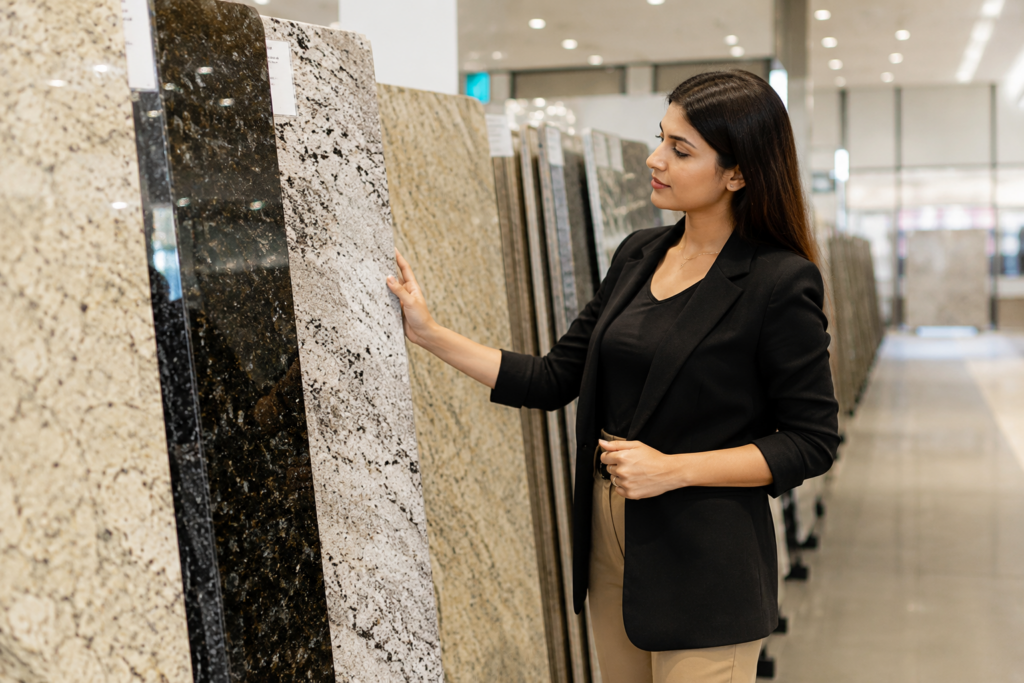
When you’re building a new home or renovating an existing one, choosing the right granite is one of the most important decisions. Granite is not just a decorative material—it’s a long-term investment that adds beauty, durability, and value to your property.
However, many homeowners struggle with questions like:
- How do I know if the granite is genuine?
- Why do granite prices vary so much?
- Which granite is best for flooring or kitchen countertops?
- How can I avoid low-quality granite?
- What should I check before buying?
Why Choosing the Right Granite Matters
Granite is expected to last for decades. A poor-quality stone may develop cracks, lose its shine, or absorb stains over time. High-quality granite offers:
- Exceptional durability
- Scratch and heat resistance
- Low maintenance
- Timeless appearance
- Higher property value
That’s why selecting the right granite from a trusted supplier is just as important as choosing the right design.
1. Check the Granite’s Thickness
One of the first indicators of quality is thickness.
Standard granite thickness includes:
- 16–18 mm – Suitable for wall cladding
- 20 mm – Common for flooring
- 20–30 mm – Best for kitchen countertops and staircases
Uniform thickness ensures better strength, easier installation, and a premium finish.
2. Inspect the Surface Finish
Premium granite should have:
- A smooth, mirror-like polish
- Consistent shine
- No dull patches
- No visible scratches
Run your hand across the surface. It should feel perfectly smooth without rough spots.
A quality polish not only enhances beauty but also protects the stone from moisture and stains.
3. Look for Natural Patterns
Every granite slab is unique.
High-quality granite has:
- Natural grain patterns
- Uniform color distribution
- Rich mineral textures
- No artificial-looking prints
Avoid slabs with unusually repeated patterns, excessive resin filling, or mismatched colors.
4. Check for Cracks and Defects
Carefully inspect the slab before purchasing.
Look for:
- Hairline cracks
- Chips
- Broken corners
- Surface pits
- Excessive filling
Even small cracks can expand after installation and reduce the stone’s lifespan.
5. Test Water Absorption
Quality granite has very low water absorption.
A simple test:
- Pour a few drops of water on the surface.
- Wait 15–20 minutes.
- Wipe it clean.
If the stone absorbs water quickly or leaves a dark stain, it may not be premium quality.
Low-porosity granite performs better in kitchens and bathrooms.
6. Evaluate Color Consistency
Natural granite will always have slight variations, but the overall color should remain consistent across the slab.
Large differences in shade may indicate:
- Different quarry batches
- Lower-grade material
- Poor quality control
Always inspect the entire slab before making your selection.
7. Choose Granite Based on Application
Different areas of your home require different granite types.
Kitchen Countertops
Choose granite that is:
- Heat resistant
- Scratch resistant
- Low maintenance
- Easy to clean
Flooring
Look for granite with:
- High compressive strength
- Slip-resistant finish (where required)
- Excellent polish retention
Staircases
Choose thicker granite with durable edges and consistent color.
Wall Cladding
Lighter-weight granite with elegant finishes works best.
8. Ask About the Granite’s Origin
Granite from reputed quarries generally offers better consistency and durability.
Reliable suppliers maintain strict quality standards from quarry to finished slab.
Knowing the source also helps ensure you’re getting authentic natural stone rather than low-grade alternatives.
9. Compare Price with Quality
Many buyers make the mistake of choosing granite based only on price.
Cheaper granite may involve:
- Lower-grade stone
- Thin slabs
- Poor polishing
- Hidden cracks
- Inferior finishing
Instead of asking, “Which granite is cheapest?”, ask:
“Which granite offers the best long-term value?”
Quality granite lasts for decades, making it a smart investment.
10. Buy from a Trusted Granite Manufacturer
The supplier you choose is just as important as the granite itself.
A trusted manufacturer offers:
- Premium-quality slabs
- Wide range of colors
- Accurate sizing
- Professional finishing
- Reliable customer support
- Transparent pricing
Working directly with an experienced manufacturer also ensures better quality control and competitive pricing.
Common Mistakes to Avoid
Many homeowners unknowingly make these mistakes:
❌ Buying only based on price
❌ Ignoring slab inspection
❌ Choosing the wrong thickness
❌ Not checking polish quality
❌ Purchasing from unreliable suppliers
Avoiding these mistakes can save significant repair and replacement costs in the future.
Frequently Asked Questions
Which granite is best for home interiors?
The best granite depends on your application. Dense, low-porosity granite with a high-quality polish is ideal for kitchens, flooring, staircases, and wall cladding.
How can I identify premium-quality granite?
Check for:
- Uniform thickness
- Smooth polish
- Natural patterns
- No cracks or chips
- Low water absorption
- Consistent color
Does expensive granite always mean better quality?
Not necessarily. Price depends on rarity, origin, thickness, and finish. Always inspect the granite rather than relying solely on cost.
Maharana Granites
Maharana Granites proudly serves customers across India With a commitment to quality and timely delivery, we bring exceptional stone solutions closer to you, wherever you are.